Your guests will spend two weeks planning a fantasy lineup. Most restaurants give football season restaurant prep about twenty minutes. Here’s the lineup worth setting before September 9.
Somewhere this week, one of your regulars is going to spend three hours arguing about a fourth-round pick. They’ll study bye weeks. They’ll read injury reports on a running back they have never once watched play. They will take it extremely seriously.
Then on Sunday, they’ll decide where to order $200 of food in about ninety seconds.
That asymmetry is the opportunity. Football season gets treated like one big day in February, the day everybody plans for. It isn’t. It’s eighteen consecutive Sundays of the same compressed, predictable, high-ticket rush, starting Wednesday, September 9 and running into January. The one day in February gets a war room. The other seventeen get whatever was already on the schedule.
What game-day demand actually looks like
The defining feature of game-day demand isn’t the volume. It’s the shape.
On Big Game Sunday 2025, DoorDash took more than 5.7 million orders and peaked at over 9,300 orders per minute between 6:00 and 6:30 p.m. ET, roughly 155 orders a second inside a thirty-minute window. Wings led at 639,000 orders; pizza came in right behind at 637,000.
Regular-season Sundays are a smaller version of the same curve, thirteen games at a time. Your Sunday isn’t busier than your Friday by some flat percentage. It’s the same day’s worth of orders trying to land in one hour, and the hour is set by a television schedule you don’t control.
Everything below follows from that one fact. Good football season restaurant prep starts with the shape of that curve, not the size of it.
Five game-day plays most restaurants miss
Fantasy players have a word for the pick nobody else is looking at. Here are five for the restaurant side of Sunday.
1. The pre-game daypart
Kickoff is when the food arrives. It is not when the day starts. Group orders get decided hours ahead, and the person making the decision is thinking about food by late morning. If your Sunday opens at eleven and your online ordering opens with it, you’ve missed the window where the decision actually happens and handed it to whoever was open.
Set it: Sunday hours that open before the decision, and a short pre-game menu live on every channel at the same time.
2. Orders that arrive before the rush does
Every order you move out of the 6:15 crush is one you fill accurately with the staff you already have. This is the one that matters most on the list, and it isn’t a marketing problem; it’s an ordering problem. Time-slot ordering lets a guest pick their own pickup window. Guests like it because the food is ready when they said. You like it because you’re smoothing your own curve instead of surviving it.
Set it: Open Sunday pre-order windows by Friday, and give guests a reason to choose an early one.
3. The bundle that removes the decision
A game-day order is a group decision, and group decisions are slow and error-prone. A named bundle at a fixed price does three things at once: it raises the ticket, it shortens the decision, and it gives your kitchen a fixed SKU to prep against instead of a guess. Predictable prep, the kind recipe management and a kitchen display system are built for…is what keeps a 6:15 rush from becoming a 7:00 apology.
Set it: Two or three bundles at clear price points. Feeds four, feeds eight, feeds the whole room.
4. Curbside on game-day terms
On a normal Tuesday, curbside is a convenience. At 6:20 on a Sunday, it’s the difference between hot wings and a one-star review. The guest is in your lot watching pregame on their phone. They are not coming in, and nobody inside knows they’re there.
Set it: Arrival notification with name and vehicle, a text when the order goes out the door, and one above-store view where a manager sees every pickup, delivery and phone order at once, instead of three screens and a guess.
5. Gift cards sold in September, spent in December
Every fantasy league has a buy-in and a prize pool, and every office has a pool of some kind. Right now, during draft week, that money is being collected by a commissioner who has not yet thought about what the prize actually is. A gift card is revenue today and a guest in December, which happens to be the month you’d most like one.
Set it: A visible offer during draft week, aimed at commissioners rather than diners.
Football season restaurant prep across multiple locations
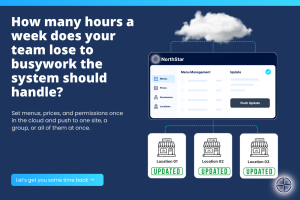
If you run one location, all of the above is a decision. If you run forty, it’s a deployment and that’s where good football seasons quietly turn into mediocre ones. Not because the food was wrong, but because the bundle went live in twelve stores, the price was different in three, and the pre-game menu never made it to the kiosk at all. Central configuration in your point of sale exists so that one decision reaches every site the same way. Push it once, everywhere, and spend Sunday watching orders instead of chasing them.
Set your lineup before kickoff
Wednesday, September 9. Thirteen games on Sunday the 13th. Then seventeen more Sundays after that.
Your guests are drafting this week. Worth doing the same.
See how NorthStar handles a Sunday rush →
#findyournorthstar