Restaurant technology costs rarely show up as one big line item, it’s the gaps between the tools that add up. Creeping payment-processing fees, orders lost between disconnected systems, hours of manual reconciling, and downtime during peak service add up to real money, and most of it never appears on an invoice. Running your POS, order channels, kitchen, gift, loyalty, and reporting on one platform closes those leaks and gives back labor, time, money, and margin.
Most operators can tell you their food cost and their labor percentage cold. Far fewer can tell you what their technology is actually costing them because the bill is scattered across a dozen places, and half of it never shows up on an invoice.
If you run multiple locations, the number is bigger than you think. Here’s where it hides.
Restaurant Technology Costs You Can See
Some of the leaks are sitting in plain sight, if you know where to look.
- Payment processing fees that creep. A POS whose real business is payments will quietly raise your processing rate a few points at a time, the way a frog never notices the water heating up. By the time you catch it, switching feels too hard, so you keep paying. Over a year, across every location, a “small” rate creep is one of the largest hidden costs in the building. The National Restaurant Association has tracked this shift as operators lean harder on technology to offset rising costs.
- Orders lost between systems. When your dine-in POS, online ordering, and delivery apps don’t talk to each other, orders slip through the cracks. Every online order that never hits the kitchen is a refund, a comp, and sometimes a guest who doesn’t come back.
- Prices that are wrong at one store. A price that’s right at one location and wrong at another is margin walking out the door, one ticket at a time and nobody notices until the numbers don’t add up.
- Downtime during the rush. Nothing ever breaks on a Tuesday at 2pm. It breaks on a Friday night when you’re slammed. A POS down for a couple of hours during peak service can cost you three to five thousand dollars in a single shift.
The costs you can’t see:
The bigger leaks are the ones that never generate a bill at all.
- The hours your GM spends changing a price at every location, one login at a time.
- The manager who rebuilds a spreadsheet every Monday to make four systems agree.
- The tip math done by hand at close. Slow, error-prone, and a magnet for disputes.
- The kitchen station that’s quietly slower than the rest at every location, dragging ticket times, and no one can see it to fix it.
None of that shows up on an invoice. All of it is labor, time, and margin, paid for in your team’s hours and your guests’ patience.
It’s not the line items. It’s the leaks.
That’s the real cost of a patchwork: not the software line items you approved, but the leaks between the systems you never counted. Add it up across a year, and those restaurant technology costs quietly outgrow the software line items you approved.
And because the costs are spread across so many vendors and so many shifts, they’re easy to ignore, right up until you try to grow. Every new location multiplies the leaks. The same pattern shows up behind the line, where good enough kitchen operations quietly drag down service.
How one system closes the leaks:
When your POS, order channels, kitchen, gift, loyalty, and reporting all run on one foundation, the gaps disappear:
- Orders stop falling between screens. An order placed online is the same order the kitchen sees and the same line on the report.
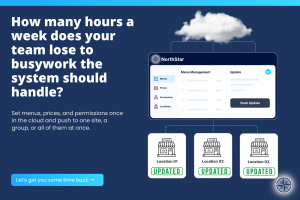
- A price change is one change, everywhere. Set it once and it’s live at fifty locations — no store-by-store logins, no drift.
- The numbers come from one place. One source of truth means no Monday spreadsheet to make four systems agree.
- You can see the slow station before it costs you the rush — and coach it, instead of finding out in next month’s labor report.
- You stop paying for a stack of vendors that don’t add up to a system.
Fewer tools doing more. Less time fighting software, more time on the floor.
Whose side is your POS on?
Here’s the question most evaluations skip: where does your POS company make its money?
If the answer is a percentage of your card transactions, you and your POS are not on the same side. Their incentive is more volume through your terminal and rates that climb one point at a time.
We built NorthStar to make money from software, not from a cut of your processing. That means our incentive is simple: make you more efficient and keep you longer. When you grow, we grow. Ask any POS company where their revenue comes from the answer tells you whose side the system is on. That’s the simplest way to think about restaurant technology costs: whoever profits from your volume decides whose side they’re really on.
What “one system” gives back:
Consolidation isn’t the goal but, what it gives back is.
- Money — no fee creep, fewer lost orders, no rip-and-replace bill every time you grow, and no separate invoice for every add-on.
- Time — set a price once instead of store by store; real-time numbers instead of a weekly spreadsheet.
- Labor — automated tip math, fewer manual steps, and kitchen visibility that lets one manager run a tighter line.
- Margin — the ability to see a leak this week, not next month, and fix it before it compounds.
We’re not here to sell you more. We’re here to help you keep more of your time, your labor, and your margin, so your team can spend the day on guests instead of on software. Lower restaurant technology costs simply mean more margin left for guests instead of software.
Run your own numbers…
You don’t need a study to find these costs. In one afternoon you can:
- Pull your effective processing rate for the last 12 months and look for the creep.
- Add up refunds and comps tied to orders that never reached the kitchen.
- Estimate the manager hours spent every week reconciling systems by hand.
- Put a dollar figure on one peak shift of downtime.
Add those four numbers together. That’s a floor, not a ceiling and it’s almost always more than the software itself. That number is your real restaurant technology costs, not the sticker price on any single tool.
#findyournorthstar