Most operators will treat it like a single game-day event. The ones who don’t will be the ones still seeing the revenue in August.
The 2026 FIFA World Cup kicks off June 11 and doesn’t wrap until July 19. Forty days. Sixteen host cities across the U.S., Mexico, and Canada. Group stage matches, knockout rounds, semifinals, and a final, spread across weekday lunches, Thursday nights, and packed Saturdays for six straight weeks.
That’s not a single spike. That’s a season.
Restaurants that plan for one big moment and coast through the rest will leave real volume behind. The operators who build a repeatable syste, tight menu, smart staffing, a follow-up plan, will be driving traffic into late summer off guests they met in June.
Here’s how to build that.
Before anything else: know what you can and can’t say
FIFA’s marks are protected, and enforcement is real. Before you design a single flyer or schedule a single post, understand the guardrails:
- “FIFA World Cup,” “World Cup 2026,” and any official logos or tournament emblems require licensing to use in marketing. Don’t use them unless you’ve gone through FIFA’s authorization process.
- Broadcasts must be live. No delayed feeds, no recorded matches.
- Public screenings must be free to attend. Ticketed events require a FIFA public viewing license. Apply through FIFA’s Public Viewing Platform.
The good news: none of this stops you from marketing aggressively. It just means your creative stays focused on your brand, your specials, and your experience which is where it should be anyway.
1. Design a menu built for volume, not variety
The temptation with a high-profile event is to add more: more specials, more LTOs, more options to signal that you’re taking it seriously. That’s usually the wrong call.
The World Cup creates demand spikes around specific match windows, not a gradual build you can staff and prep for gradually. When a game kicks off and your dining room fills in 20 minutes, your kitchen doesn’t need more SKUs. It needs fewer, better ones.
Build around shareable formats that move fast and hold margin: platters, snack bundles, pitcher deals, family-style trays. For off-premise, develop two or three pre-order packages that travel well and can be reproduced consistently from Group Stage through the Final. If a menu item creates prep complexity, slows the line, or drags contribution margin, pull it for the tournament. It doesn’t matter how popular it normally is.
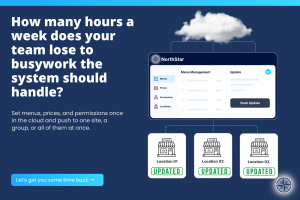
NorthStar’s Order Entry lets you configure LTOs with specific date windows and update your menu from the back office without touching every terminal. When you’ve got a room filling up and a match starting in ten minutes, that kind of control matters.
2. Promote early, promote specifically, promote often
Six weeks of matches is six weeks of reasons to show up but only if guests know what they’re showing up for.
Start promoting before the tournament opens across every channel you have: social, email, SMS, in-store signage, your online ordering flow, your reservation confirmation. Don’t wait until opening weekend. The operators who fill their dining rooms for weekday Group Stage matches are the ones who gave guests something specific to plan around weeks in advance.
Vague beats nothing, but it doesn’t beat specific. “We’re showing the World Cup” is ambient noise. “Open at 10 AM for Saturday matches, group platters available to pre-order by Thursday, sound on for U.S. games, patio seating first-come” gives guests a reason to commit.
Build a cadence, not a campaign. Leverage partners like Paytronix and Thanx. One big launch post and then silence won’t carry you through six weeks. Map out the major match windows, opening day, any U.S./Canada/Mexico games, the knockout rounds, the Final and plan content around each one. Treat it like a content calendar, not a single activation.
3. The tipping problem nobody’s briefing their staff on
Host city restaurants are going to see more international diners over these six weeks than most will see in an entire year. And the friction point that’s going to catch the most teams off guard isn’t language or dietary restrictions.
It’s the check.
U.S. tipping norms are genuinely confusing to guests from Europe, Latin America, and elsewhere, not because they’re unwilling, but because the system is opaque. Many European visitors come from cultures where rounding up or leaving a few coins is the norm. They’re not being cheap. They don’t know that 20% is the expectation, that it’s built into the math of how your staff gets paid, or that a service charge isn’t automatically included.
The answer isn’t to lower expectations. It’s to make the process more transparent:
- If you apply auto-gratuity for large parties, it needs to be on the menu and on the check, not buried in fine print that an international guest won’t read.
- Train your staff on a single clean line they can deliver naturally: “Gratuity isn’t included unless it says so on the check, you can select an amount on the screen or I can help you.”
- Review your tip prompts. High percentage presets can feel aggressive to guests who aren’t used to the format. In bar or counter-service settings, dollar-amount options may land better than percentage defaults for international guests.
This is a staff training moment, not just a POS configuration. Brief your team before the tournament starts, not after the first bad Yelp review.
4. Build the follow-up before the tournament ends
Here’s the math most operators miss: the guest who orders a group platter during the Round of 16 is worth significantly more if they come back twice before Labor Day than they are as a one-time tournament customer.
The World Cup will drive new traffic, people who might not normally be in your dining room or ordering from your app. If you don’t have a plan to re-engage them, you’re doing event marketing with no retention layer. You’re renting guests instead of building a customer base.
Every touchpoint during the tournament is an enrollment opportunity. Online orders, waitlist sign-ups, table reservations, catering pre-orders, each one is a chance to capture contact information and bring guests back. Build a follow-up sequence before June 11: a bounce-back offer after their first visit, a loyalty enrollment prompt at checkout, a targeted campaign tied to the knockout rounds or the Final.
For off-premise specifically: if tournament demand drives delivery and takeout volume, don’t let third-party marketplaces own that relationship. Get inserts or QR codes into those orders that drive guests back to your direct channel next time. You cut the commission and you actually own the guest data for future marketing.
The tournament ends July 19. Your job is to still be talking to those guests in September.
The bottom line
Forty days, multiple match windows, and a dining room full of guests who’ve never been in before, that’s the opportunity. The operators who come out ahead won’t be the ones who did the most. They’ll be the ones who simplified their menu, started promoting early, briefed their staff on the checkout experience, and had a plan to bring people back.
That’s how a soccer tournament turns into a Q3 revenue story.